
Bentall Centre
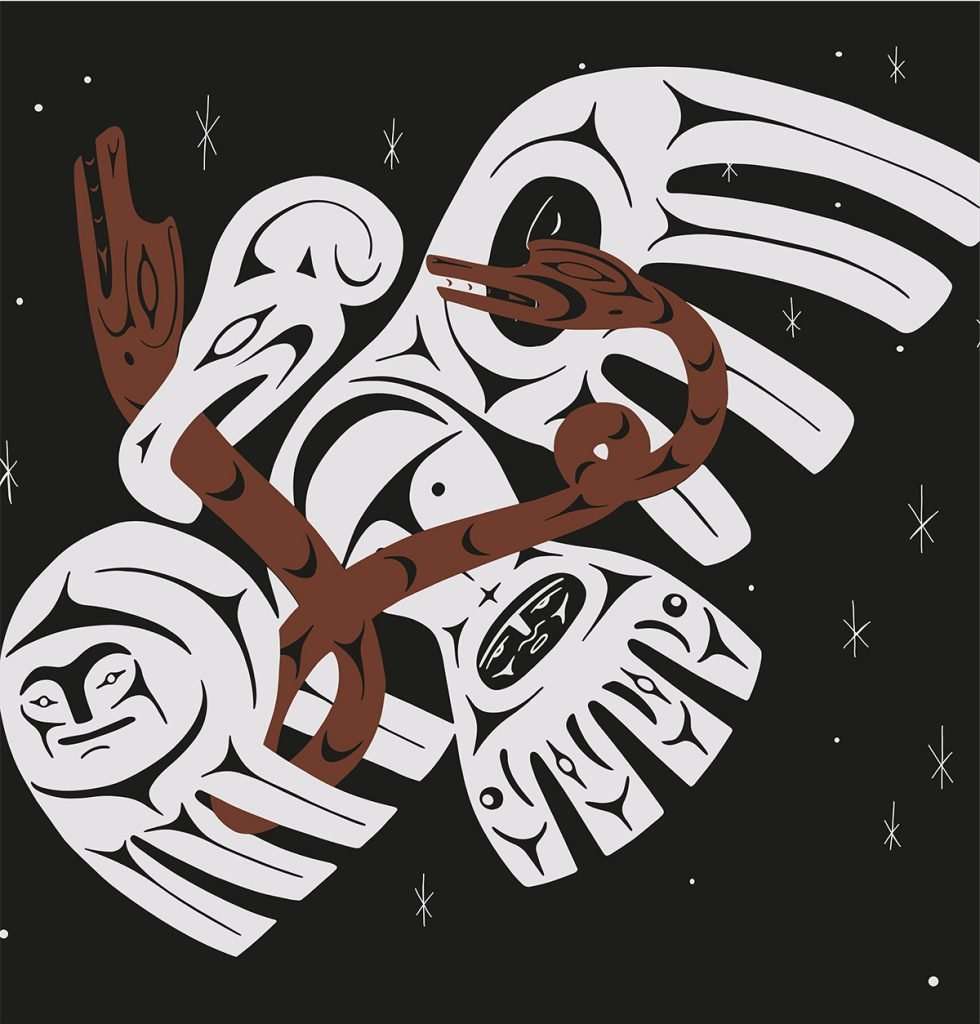
Sxwuxwa’us ‘i’ Si:nlhqi’ (Thunderbird and Two-Headed Serpent)
The design depicts two of the most powerful creatures in our world. Two of the most powerful helpers. They are grappling with each other but not in combat—in that sense it is a false dichotomy. The relationships between things in nature exist outside of morality. The “good” or “bad” is something imposed by us as we struggle to make sense of something that transcends our understanding. This isn’t a scene of a fight, but just an engagement between beings; an engagement from which will come an understanding that is new as their energies come together.
This also represents the journey that I have taken as I work to learn more about my culture and art. While so much has been lost, there is also so much that is there and remains in the teachings passed down in families, that exists in people, in texts, teachings that exist in the land. It is hard work to learn, and the more that you learn the more that you realize you don’t know. This is a journey that doesn’t end. Learning is sacred. Doing the work to learn is sacred.
Eliot White-Hill, Kwulasultun (he/they) is an artist and storyteller from the Snuneymuxw First Nation in Nanaimo, BC. His family roots are with the Rice family of Penelakut, the Hamilton family of Hupacasath and further up and down the Northwest Coast. His interdisciplinary art practice is rooted in honouring and celebrating the teachings, stories, and world views passed down by his family, communities, and Coast Salish and Nuu Chah Nulth cultures. He works across a range of mediums, including digital art, painting, sculpture, printmaking, installation, creative writing, and curation. He graduated with a Master’s of Fine Arts from Emily Carr University in 2023 and currently resides on the territories of the Musqueam, Squamish, and Tsleil-Waututh peoples.
The Lantern City is grateful to be held on the traditional, ancestral, and unceded territories of the Coast Salish peoples of the xʷməθkwəy̓əm (Musqueam Indian Band), Skwxwú7mesh (Squamish Nation), and Səl̓ílwətaɬ (Tsleil-Waututh Nation). We acknowledge our privilege to be gathered on this land, and commit to work with and be respectful to the Indigenous peoples whose arts and stories inspire us to bring communities together.

